Showing posts with label Jordan. Show all posts

Sunday, January 24, 2016

From the Dead Sea to the Red Sea


Sunset over the Dead Sea
My time in Jordan has come to a bitter sweet end. Bitter because I truly enjoyed being there. I was surrounded by good company and the work I was doing at Genome Training and Consulting was top notch. It's sweet because I am back in Senegal, a country I've held close to my heart for 5 years, and a place that I left all to soon when I got sick in September.

Paris Square - my temporary home
The Hashemite Kingdom of Jordan is known for being a peaceful safe-haven in the Middle East and bordered by conflict and turmoil. Inside of it's borders is a harmonious alloy of ancient and modern. Its deep and rich history comes to life when you're visiting its historical locations.


The Dead Sea
This weekend get away was extra special for three reasons, it was a surprise anniversary vacation, it was my first stay in a 5-star resort, and its the Dead Sea! People live lifetimes with this on their bucket list and often times never make it.

Salt build up
The Dead Sea is a place many people dream of going and only a few make the trip. At 429 meters (1,407 feet) below sea level, it is the lowest poin on earth and has such high salinity that nothing but the most microscopic of life forms can survive inside of it. The sea, or should I say lake, is the second-saltiest body of water on earth, after Lake Aral in Djibouti.


It's mud is mineral rich (mostly with calcium and magnesium), packaged, and sold all over the world for exorberant prices. And here I had as much as I wanted all to myself! I did a full body mud wrap three times while there! In ancient times, the Egyptians used this mud, sometimes called bitumen, during their mummification process.

Dead Sea mud exfoliating time
Sadly the Dead Sea has shrunk by 30% in recent years (approx 1m per year) due to evaporation and agricultural demands. The feeling of effortlessly floating in the water is indescribable...if this isn't on your bucket list, it should be. And if it is, you better get there soon!


Amman
This may be the coolest capital city I've ever lived in. OK, it's the only capital I've lived in, but my statement stands. I'm not sure if I feel right counting my five weeks in Senegal before I got sick, but I will soon be living in another capital city. I've always been a "small town" girl, the only other true city I've lived in was Montreal, Quebec, so this has been a wonderful experience for me!

As you'd figure, there's a lot to see and do in the city. Apart from cute cafes and delicious restaurants (you can find anything here, sometimes pricey but usually worth it), there is enough history to keep you busy every weekend for months. The list of where I've visited is in no way exhausted and will surely be added to at a later date.

Amman Citadel

A site that has an enormous history of occupation by a variety of civilizations. It has been built, destroyed, rebuilt and is now preserved for us to visit.


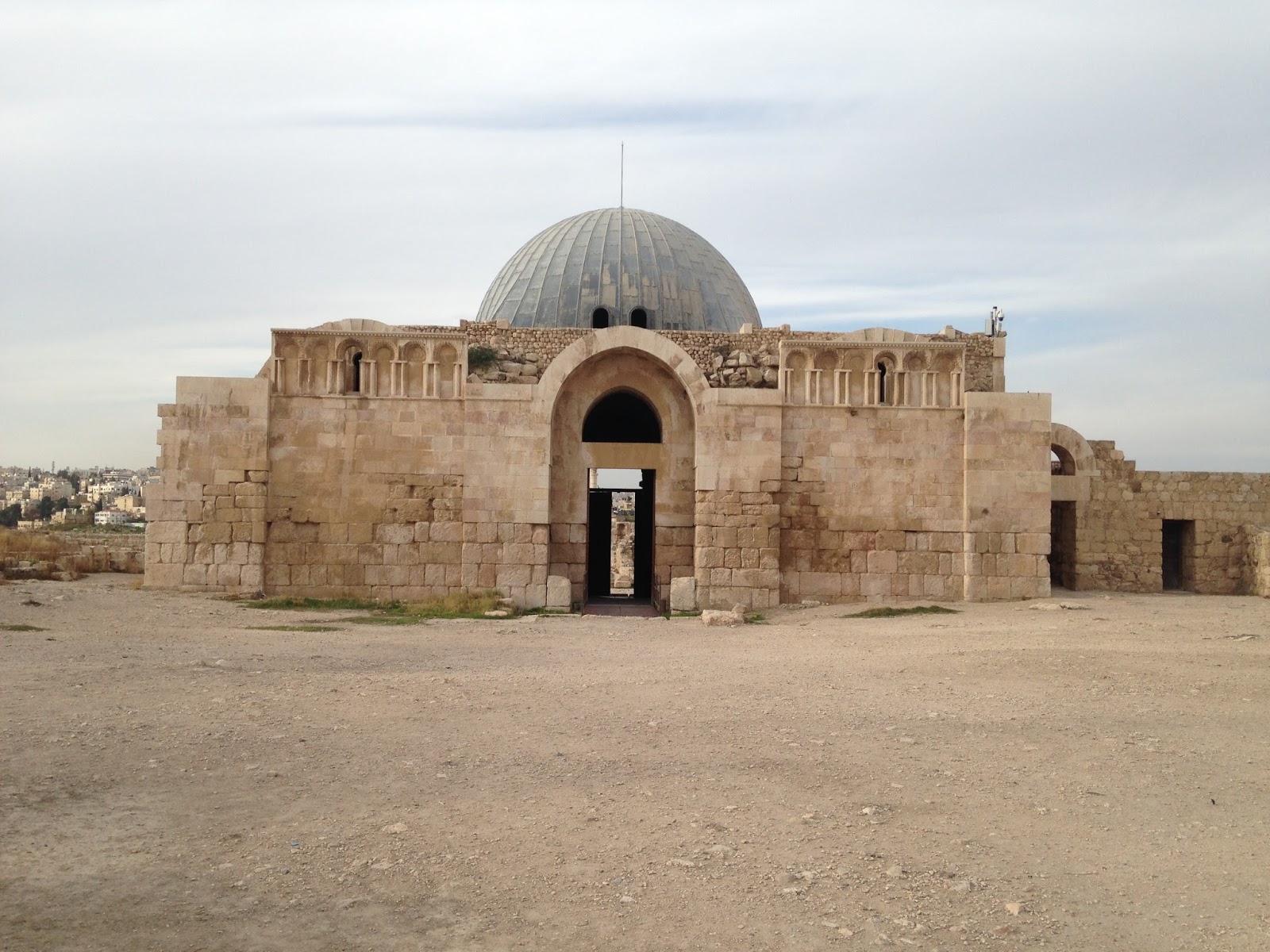
Umayyad Palace
Hanging out in the ruins
Hand of Hercules

"Look!" View of Amman from the Citadel
Roman Philadelphia Amphitheater

Smack dab in the middle of Amman, which in ancient times was called Philadelphia, the theater seats over 6000!
Hard to see me but I'm a dot in the middle :)
Rainbow Street

Everything fun is here. Bars, cafes, shisha, ice cream, alcohol, yoga, great views, restaurants, etc.

View from a friends house just off of Rainbow Street

Downtown

I was warned not to go here on Fridays, especially around prayer time, but I haven't had any negative experiences. Downtown, like Rainbow St. is flooded with shops, restaurants, and cute cafes that you can post up in for half a day to pump out some work.

Lemon with mint - a classic!
For more on Jordanian/Middle Eastern food, check out this post. 

King Abdullah Mosque

Regrettably, this mosque was under construction when I visited AND it was prayer time so I didnt get to go inside. This is Amman's largest mosque and named after the present King. Whats so neat about it (besides its size) is that there is not one column inside. It's this massive open dome!


Church right next door to the mosque.
Abu Darwish Mosque

The Abu Darwish Mosque was built in 1961 on top of Ashrafiyeh (one of Amman's 7 hills). It was funded by a Jordanian born in the Caucasus (by the name of Abu Darwish), embraced Syrian architecture and was built by Palestinians. The alternating black and white stones make this mosque one of a kind and can accommodate 7000 worshipers!


Lucky for me when I went I made it just in time for the Adhan, or call to prayer. What a beautiful sight watching worshipers gather to their holy place.

Street Art of Amman

Enough said. I gained a new appreciation for it during me months in Amman.


The Desert Castles
My first trip outside of Amman was east of Amman to what are known as "the Desert Castles". Although I didn't see all of the castles, I saw enough to know two things:
1. I will be back to see them all.
2. Definitely worth a day trip.

Heading east from Amman, the landscape quickly turned into a barren stone desert known as the badia. I had gotten used to the bustling, green, hilly life in Amman so this day-trip was truly a pleasure. This is what 80% of Jordan looks like and where 5% of its population lives.

There are six desert castles along the "desert loop" most of which were build or adapted by the Damascus-based Umayyad rulers in the late 7th and early 8th centuries.

Qusayr Amra with our guide Mumbarak
Our first stop, after getting pretty lost and taking the roan highway, was Qusayr Amra or Amra palace. Qusayr is little castle in transliterated Arabic. Here we found a welcoming guide, Mumbarak who showed us around the small castle making small jokes and hurrying us along.

This desert castle is a UNESCO World Heritage sight because it is the only monument in the world from the Umayyad period that has preserved its panted decoration in totality.


Inside of Qusayr Amra


After snapping enough pictures we were invited into share some Bedouin whiskey, also known as chai or even more commonly as tea.

My new friend
After two, or maybe three rounds of tea and a couple of story exchanges, it was time for us to head out to out next castle. But not before a near marriage proposal and a beautiful red bracelet as a gift.

Qasr al-Kharana
The date and original function are debated between scholars but that Qasr al-Kharana, or Kharaneh, or Haranna (I saw three different ways to spell it all on the same trip) may have been the oldest khan (inn) of the Islamic period.


This castle was much larger and more open than the first. We took our time exploring each level, climbing up and down the stairs, and of course, soaking in the view from the rooftop.

Next time I will be sure to see Qasr al-Hallabat, Qasr al-Azraq, Qasr Uweinid, and Qasr al-Mushatta.

Roof top of Qasr al-Kharana
After this we were ready for lunch. We decided to grab some food and get lost. The getting lost was not intentionally - so we pulled over on a random road and ate lunch Jordanian style. On our attempt to find the main road, we were flagged down and invited in for tea.


Smiles transcend language barriers
A little music with a homemade guitar/violin type thing

Petra
I hitched a ride to the Rose Red City with SIT Graduate Institute students that were in Jordan for a couple of weeks on their field study. This city was built by the Nabateans, a nomadic tribe from western Arabia, in abut 6th century BCE but was only know by the Bedouin until 1812.


This mystical city that was lost by civilizations for centuries has become so popular its now reportedly one of the seven wonders of the world. I say reportedly because I can never find an "official" site - does anyone know of one? Every site I find is a little different.

The major sights of Petra, beyond the red mountainous backdrop that made for a picture perfect view at all times, include the Siq, the Treasury (Al-Khazneh), Street of Facades, the High Place of Sacrifice, the Theater, several royal tombs and the Monastery (Al-Deir). I read up a bit the day before so that I could maximize the short amount of time I had inside the city. The consensus was in - head for heights! I knew a half day in the city, especially with my back, I wasn't going to be able to see much - I needed to be organized and efficient.

The classic photo walking from the Siq entering Petra where you can see the Treasury
Straight chillin in front of the Treasury
On our way in to the city, we passed countless tombs, the siq, an advanced aqueduct system, massive narrow stone corridor leading to the magnificent Treasury. I can imagine this may be where the saying "That's a sight for sore eyes" may have come from. The city was a massive Nabatean trading center where people from all over the world would arrive trade spices, silks, incense, etc., so arriving to the Treasury must have left traders with an overwhelming feeling of accomplishment and relief.


The hike to the High Place of Sacrifice was a long one, to say the least. But every time I managed to look up from watching my feet on the ground making sure not to trip, I had to take a second (or two, or three) to admire the natural beauty that all around me. As we neared the top, or what we thought was the top, I heard a flute being played off in the distance. A Bedouin woman was up hanging out by her shop waiting for tourist to pass by.


This hike was over 1000ft incline and over 15,000 steps!! At the time, because of exhaustion, I kept saying "This was not worth it" but not in hindsight, which we know is always 20/20, it was totally worth it.

Instead of taking a different way down (which was much longer and would have allowed us to see more) we went down the way we came up. I was exhausted and there wasn't much time left.


The Roman Amphitheater and several tombs where right at the base of the climb up to the High Place.

Amphitheater of Petra

Red Sea - Aqaba and Tala Bay
Surprisingly to me, Aqaba the most important city in southern Jordan and is on its way to being the country's second biggest city. There are tons of development projects including suburbs, malls, and luxury apartment complexes sprouting up all over. It's already home to several international hotel chains that continue to expand along the coast.

The JETT Bus from Amman to Aqaba was only 10$ and took about 4 hours. It was affordable, reliable, and comfortable.

Calm sunny day on the Red Sea
The Gulf of Aqaba, which is essentially the Red Sea, has over 110 species of hard coral, 120 species of soft coral and nearly 1,000 species of fish! It's a hot spot for divers, snorkelers, and beach loves alike.

A sunken tank
Sadly it was on the cold side for my liking (especially with my back - it's bad for me to get really cold), so I only dipped my feet in. However, I was able to get underwater in another way... a 360 degree submarine glass boat! We saw cabbage, brain, and branching coral - parrot, tiger, barracuda, angles, zebra fish and more. Coral, on average, grows 1 centimeter per year -- the coral we saw was over 10,000 years old.

Coral
Sunset over the Read Sea


I know I'll be back to Jordan, I have a lot left on my bucket list to see. Priorities will be Madaba, Karak, Salt, Ajloun Castle and Forest, Umm Qais, Dana Nature Reserve, Wadi Musa, Wadi Mujid, Wadi Rum, Jerash Market and Ancient Ruins, and as previously mentioned, the rest of the Desert Castles. Hoping to get to Lebanon too, inshallah. But from here on out - blogs will be about Senegal!

Wednesday, December 16, 2015

Jordan/Middle East Bucket-list


    So far the list is just for Jordan - but once I get some more time to hash out things I want to see and do (and when my back is better), I'll expand :)
      1. Try all of these foods and drinks
      2. Partake in a two-day adventure in Petra (technically only one day)
      3. Spend a "bedouin night" under the stars
      4. Wine tasting at the Winemaker, the Zumot Wines’ tasting rooms just outside Amman
      5. Take Arabic classes
      6. Check out the Farmer's Markets of Amman
      7. Dip my toes and hands into the Jordan River
      8. Hike around Wadi Mujib.
      9. Visit the Dana Biosphere Reserve
      10. Jerash (and the market!)
      11. Go east of Amman to see the "Desert Castles" (still have 2 left to see)
      12. Umm Qais
      13. Long Drive along King's Highway, created to help east the pilgrimage to Mecca way  back when.
      14. Learn to cook Mansaf (traditional and most famous Jordanian dish)
      15. Ancient Amman (including the citadel and the amphitheater)
      16. See the mosaic map of the Holy Land in Madaba
      17. Wadi Rum!
      18. Go for a little swim in the Red Sea and the Dead Sea (technically I only dipped my feet in – too cold to swim)
      19. Mount Nebo and Mount Pisgah
      20. Ajlun Castle 
      21. Feast my eyes on King Abdullah I's Mosque 
      22. Jordan Archaeological Museum (in the citadel)
      23. Take a nice relaxing swim in the Ma'in Hot Springs 
      24. Walk down al-Wakalat Street and al-Rainbow street in Amman
      25. Ummayad Palace (in citadel)
      26. Darat al Funun 
          This is the longest bucket list I have ever made!!
          But I figure, I'll be back - maybe several times...


          Have you been to Jordan or the Middle East??
          If you think of something I should add, 
          leave a comment and let me know!

          Thursday, December 10, 2015

          اكل : Akel : Food

          Today marks exactly thirty-five days 
          since my arrival in Jordan!

          Noted: Working from Arabic to English is extremely difficult because I dont know the Arabic alphabet and for me - I have to first find someone to transliterate a word from Arabic and then translate from the transliterated Arabic. Confusing right? This word was pretty new to me - "transliteration" but it makes sense and I like it - it makes reading Arabic easier, even though its not really Arabic anymore.

          For example, the title of the post: اكل : Akel : Food
          This goes from Arabic to transliterated Arabic to English.

          My short lived hopes and dreams of taking Arabic classes while in Jordan were squashed with the reality of TIME. I have no time here. I came here to "recover" but like my Dad, I can't sit still.

          The last couple of weeks I've been really trying to "dive" into Jordan. I only have a short time here and want to soak up as much food, culture, music, sightseeing, and tradition as I can.

          I've always said the fastest way to learn about a new place/
          group of people is through their food (and music). This is my 
          culinary experience thus far:

          Mezzes are appetizers and here in Jordan. They are a must before dinner or even as a snack during the day. They include foods such as hummus, baba ghanoush, kibbe maqliya, tabouleh, falafel, and za'tar. This list is not exhausted but are some of the most popular in the Levant (a region that generally includs Cyprus, Egypt, Iraq, Israel, Jordan, Lebanon, Palestine, Syria, and Turkey) and usually eaten with pita bread (a type of flat bread with a pocket)!


          -Hummus, as many of you likely know, is a cooked/mashed chick pea base dip or spread made with tahini, olive oil, lemon juice, salt and garlic.
          -Baba ghanoush is cooked eggplant mixed with onions, tomatoes, olive oil and various seasonings.

          -Tabouleh, in addition to falafel and hummus, is another dish I had known before arriving here in Jordan. Its comprised of finely chopped tomatoes, parsley, mint, bulgur and onion. Then, seasoned with olive oil, lemon juice, and salt. Sometimes people will substitute couscous for the bulgur and some people add garlic. It's so fresh, light and healthy!
          -Falafels are everywhere and ridiculously cheap! The deep-fried balls made from ground chickpeas and/or fava beans can be found on nearly every corner for less than 50 cents.
          -Za'tar, the name of my boss's dog, is a powerful blend of herbs, sesame and salt that is usually put on bread. It sort of reminds me of the italian type herbs/spices they give you before the main course at fancy restaurants.
          -Kibbeh maklieh, sometimes more commonly known as fried kefta, are fried balls of beef and crushed wheat that are stuffed with spiced ground beef and pine nuts.

          Kibbeh Makleih!

          Another "appetizer" or smaller meal is Al-Rashoof Soup which consists of coarse wheat flour, yogurt and lentils. I was told this is often times served before/with Mansaf.

          Found this soup at Souq el Sodfeh (سوق الصدفة) Farmers Market in Jabal al-Weibdeh
          Al-Kabseh (also written Kabsa), which Jordanians tell me is a Saudi dish, is red rice with chicken, vegitables, and lots of spices (cardamom, saffron, cinnamon, black lime, bay leaves and nutmeg). Apparently, Mandi is a type of Kabseh so I guess I have tried this type of dish after all. Mandi has probably been my favorite food so far - not including the mezzes! The word "mandi" comes from the Arabic word nada, meaning "dew" which reflects the moist 'dewy' texture of the meat (chicken or lamb) which is cooked special in a tandoor (a cylindrical clay or metal oven). In addition to the meat, there is a redish rice and, yup, a bunch of spices with a delicious red chili sauce to pour on top.

          Another common food, both in Jordan, the Levant, and the US, is shish-kebab! Or taouk-kebab if it's chicken and kofta-kebab if it's lamb. Often times you will find that you can order a platter that has all three of these (beef, chicken and lamb) as well as kefta. Kefta. Is. Amazing. It's ground beef or lamb mixed with mixed with cumin, paprika, minced onion, coriander, mint leaves, and parsley. Sometimes people will add cinnamon, cayenne pepper - but it's optional.

          Photo credit: Frédérique Voisin-Demery/Flickr
          When I think of Maqloobeh I think of pineapple upside down cake but for dinner, and not sweet. You throw tons of chicken, rice, veggies, baharat spice and a few other goodies in a pot being careful as to not stir it while it cooks. After everything is done - you flip the pot over so its sort of like a layered casserole. Sadly when I tried this dish it was at a buffet and wasn't prepared as beautifully as it should of/could of been.  

          Manakish, quick, delicious, found on the street everywhere, and in my opinion, quite similar to pizza. Ok, not really but they are shaped the same and sort of look the same. Its pretty much baked flat dough with toppings but no sauce. Toppings include za'atar, cheese (usually one called kashkaval), minced lamb, chili, spinach, fried eggplant and more.
           As they say, save the best for last. Mansaf is by far the most beloved traditional dish in all of Jordan. you haven't tasted Jordanian cuisine until you've tasted mansaf.  lamb cooked in a sauce of fermented dried yogurt and served with rice    served on a large platter with a layer of flatbread (markook or shrak) topped with rice and then meat, garnished with almonds and pine nuts, and then sauce poured over all

          The next dishes that are on my "to eat" list (yes, I have one of those) are: Mlokhiye, Konafa, M'askhen, and Bamyeh!

          But of course, no meal is complete without argeeleh (shisha) and limon wa nana (mint, sugar, and lemonade blended).
          My first limon wa nana :)


          Do you have a favorite Jordanian or Levantine food?
          Did I miss any good ones?

          Friday, November 27, 2015

          Country Profile: The Hashemite Kingdom of Jordan


          Motto:
          الله، الوطن، الملك
          Allah - Al-Waṭan - Al-Malik
           
          God - Country - The King

          History

          The history of Jordan is too dense and too long to cover in what I was hoping to be a handful of succinct paragraphs. Know that what I write here is by no means an exhausted and fully descriptive history of what is now known as the Hashemite Kingdom of Jordan. See the bottom of this post for some suggestions on Middle Eastern and Jordanian reads.

          Pre-colonization

          According to archaeologists, there have been inhabitants in this region as far back as the Paleolithic period (or 500000 - 17000 BC). Three kingdoms sprouted out during the Iron Age (c. 1200-332 BCE) and next was the rise of the Nabatean kingdom who's capital was Petra (in the south of present day Jordan). From approximately 661 until 750 CE the Arab-Islamic Umayyad Empire, which was the first Muslim dynasty, took over Jordan and were succeeded by the Abbasids (750-1258). Jordan was ruled by various powers and empires until finally the the Ottomans, who captured and ruled major parts of the Arab World from 1516-1918 CE.

          After World War I, the Ottoman Empire was broken up and similarly to what happened in Africa - random white guys as part of the The Council of the League of Nations redrew lines on a map and called it the Middle East.

          Colonialization

          In 1922, Transjordan took shape and was recognized as a state under British "supervision". At this point, Britain also had mandates over Palestine and Iraq while France was given the mandate over Syria and Lebanon. Abdullah I was made Emir (title of various Muslim [usually Arab] rulers) and the country was split into three administrative districts (north, central and south). Slowly the British mandate began to loosen and the period between the two world wars became sort of like a consolidation and institutionalization in Transjordan. On March 22, 1946, Abdullah negotiated the Anglo-Transjordanian Treaty that ended the British mandate and allowed for full independence for Transjordan. Shortly after on March 25th, Abdullah I was proclaimed king and officially changed the name from the Emirate of Transjordan to the Hashemite Kingdom of Jordan which was shortened in Hashemite Kingdom of Jordan in 1949.


          "A women's history can never be divorced from a nation's history of confrontation 
          and struggles, especially in colonial contexts where women have been held prisoners to 
          both the colonizer and the colonized, each of whom sought control oft er the other thought 
          the control of women. The colonizer drew upon his Enlightenment universal ideal of female 
          liberation as a means for subverting and dehumanizing the local male while the latter, the 
          proverbial colonized and oppressed 'local' male, strove to control the female veiled body as 
          means for holding on to tradition in the face of the modernizing efforts of the colonizer. " 
           - Salam Al-Mahadin in "Jordanian women in education: 
          politics, pedagogy and gender discourses" (2004, p. 25)

          Post-Colonialization 

          In 1948, the British terminated their mandate over Palestine (which had been experiencing an influx of Jewish immigrants since the 1920s) and the Jews immediately proclaimed the independence of the state of Israel. The Arab Legion (Jordan, Lebanon, Syria, Egypt and Iraq) defended the Arabs of Palestine but lost. In the end, Jordan was left with the West Bank, over half a million refugees (whom received immediate citizenship) and the state of Israel remained. In 1951 King Abdullah I was assassinated and was succeeded by his eldest son, King Tala who only ruled for less than a year before his son, King Hussein took over in 1952.

          Jordan saw another massive incoming of refugees in 1967 as a result of the Six-Day War. Jordan, Egypt, Syria, and Iraq fought against Israel who during the war took control of East Jerusalem and the West Bank. Prior to this (in 1966) Jordan had a Palestinian refugee population of 700,000 - afterwards it increased by another 300,000. Subsequently, there was the Jordanian Civil War (aka Black September) that started in September of 1970 and ended in July of 1971. It was fought between the Palestine Liberation Organization (PLO) and the Jordanian Armed Forces. Over the next decades the country experienced a couple of attempted military coups (all unsuccessful), several riots (usually over increased prices), numerous boycotted elections, a suicide bombing attack (leaving 60 dead) in 2005, and a handful of PMs appointed by the King.

          Currently, Jordan is home to almost 1 million Syrian refugees in addition to 2 million Palestinian refugees, all of whom are fleeing either occupation or civil war in their country. Yes, it's true, the resurgence of Islamic militancy in the region does present a bit of a security threat in Jordan, particularly Amman. But as we have seen with the recent attacks in Paris, this heightened threat is worldwide.

          "Traditional boundaries were separated in place of colonial distinctions, while strategic support of different ethnic and religious groups created imbalances and patterns of destructive behavior that continue to rock the region. Without this legitimacy and with often conflicting goals, the instability and conflict plaguing the region has led to the displacing of millions of people both within national borders as IDPs and outside as refugees." - Will Clifton in "Jordan’s Refugee Crisis and Regional Implications" (2015, p. 2)

          Government   

          The Hashemite Kingdom of Jordan is officially classified as a constitutional monarchy that is comprised of an Executive branch, a Legislative branch and a Judicial branch, just like the US. Under the Executive branch you find the Chief of State who is the King himself, the head of the government (aka the Prime Minister) and the cabinet. This monarchy is hereditary, the PM is appointed by the King and the cabinet is appointed by the PM "in consultation with" the King. The Legislative branch is made up of the Senate (aka the House of Notables) which has 60 seats - all of which are appointed by the King and have 4 year terms. There is a Chamber of Deputies (aka House of Representatives) that has 150 seats of which 108 are directly elected by vote - 15 of these seats are reserved for women! Gee 10%, how thoughtful! I wonder if they realize women are 50% of the population? According to my co-worker, in the past there was actually more women but because "they talk too much" - the public decided not to vote as many in this time around. But hey, I can't say much coming from the United States of America -- it isn't much better there. Lastly, there is the highest court (aka the Supreme Court) which consists of 7 judges under the Judicial branch. The chief justice is appointed by the King and the other judges are nominated by the Higher Judicial Council and approved by the King.

          So from the looks of this research...the King has his hands in everything. Their national anthem is even called "As-salam al-malaki al-urdoni" which translates to "Long Live the King of Jordan", not too dissimilar to Britain's "God Save the Queen".

          This is last years Christmas card from the Royal family.
          The young man in the back left will be the next King.
          After the 2010 elections, democracy was said to "still be far off". There was only 53% voter turn out in this election which is just enough to make it credible. Many called for a boycott of the 2013 Parliamentary elections to show that the citizens demand democracy. This article is written by a Jordanian political activists goes into detail on why he states that "Jordan's constitution is weighted in favor of King Abdullah's regime." Despite all of this, USAID and others believe that Jordan is slowly transitioning from a monarchy to democracy, due to both internal and external pressure.

          According to Transparency International, Jordan is ranked 55/175 (175 is total number of countries) and scored a 49/100 (0=extremely corrupt/100=clean). TI uses their own index drawing on corruption-related data from expert and business surveys carried out by a variety of independent and reputable institutions to determine their ratings.

          Since arriving here I haven't experienced all that much "corruption" as opposed to when I was in Cameroon. However, I am learning more about this thing they call wasta which many insists is not corruption... I'm skeptical. Once I learn more, I will write about this "wasta" thing which from what I can gather, is giving people money who do you favors who may later give you money when you do them a favor. It's more complicated than that, but I'm not totally aware of it yet.


          Economy

          According to the World Bank (of whom I'm not a fan but will resort to their data as I am far to lazy to collect and analyze my own), Jordan is classified as an "upper middle income" country with a total GDP (Gross Domestic Product) of $5,422 per capita. To put this in perspective - the US is almost $55,000 per capita while Senegal is only $1,061 per capita. GDP per capita, in simple terms, is pretty much what the average amount of money a person makes in the country. Economists take the total income of a country (plain old GDP) and divide by the number of inhabitants. You can see how this number is totally off. How many people do you know who work in the US and don't make $55,000 and make way more?

          Although Jordan's economy is among the smallest in the Middle East it is rated as one of the top 10 most competitive economies in MENA (Middle East and North Africa). But sadly, Jordan doesn't really have any natural resources of their own and their government relies heavily on foreign assistance.

          66.4% of their GDP comes from services, 29.8% from industry and a small 3.8% from agriculture. Their agricultural products include citrus, tomatoes, cucumbers, olives, strawberries, stone fruits (like peaches or plums) and a few others. Their industries include tourism, information technology, clothing, fertilizers, phosphate mining, pharmaceuticals, petroleum refining, cement, inorganic chemicals and more.

          According to the Jordan Economic Monitor (part of the World Bank), Jordan's economy is continuing to recover from the Arab Spring spillovers which include Egypt's gas disruptions, the neighboring Syrian and Iraqi conflicts and associated security incidents. Only 15% of their population falls below the poverty line and life expectancy is 74 years.

          Looking past monetary figures (because we know this only paints parts of the picture), many professionals also use the Human Development Index (HDI). More recently experts have developed the Inequality-Adjusted Human Development Index, the Gender Development Index (GDI), the Gender Inequality Index (GII), and the Multidimensional Poverty Index (MPI) which use a variety of means to attempt to determine what their title says. See the photos below for details on how they come up with these rankings and where Jordan ranks.

          (Zoom in to read)

          Culture

          In terms of "ethnic groups", one may say Jordan is quite monolithic with 98% (this is debated - I've seen 97% too) being Arab and only 2% being Circassian, Assyrian, Chechen, Mandaean, Turkemen and Armenian. Approximately 97% are Muslim (predominantly Sunni) and just over 2% are Christian. There are also reports of Buddhists, Hindus, Jews and others but a very small almost unquantifiable amount.

          Don't forget this info graphic.
          It p
          uts things into perspective.
          Looking the majority "Arab" population doesn't quite do justice for the small but various number of Bedouin tribes in the country. The name "bedouin" comes form the Arabic word badawi - which means "desert dweller". Traditionally, they live in tents and move from place to place in the desert, looking for food and water for their herds of camels, sheep and goats. Bedouins mainly live in the Arabian and Syrian deserts, the Sinai Peninsula of Egypt and the Sahara Desert. Total, they are about 4 million and share their lands with other cultural and religious groups. Like many others in Jordan, the majority speaks Arabic and practices Islam.

          Map of where Bedouins are found
          One thing I found particularly interesting is the 'classification' of Bedouins which depends on what animal species are the basis of their livelihood. First and most prestigious are the camel nomads, then come the sheep and goat nomads. Although many have 'transitioned' into a more modern style of life, many have remained nomadic but one thing that transcends lifestyle choices is their pride in their culture. Bedouins have their own music, dance, chanted poetry, and more.

          Bedouin tribes and locations in Jordan

          Military

          The Jordanian Armed Forces, abbreviated as JAF, has an air-force, an army and a navy and/or coast guard (I found contradicting info) They are all under the control of the Commander-in-Chief who is none other than, the King himself. The main objectives are to: 1. Protect the Kingdom of Jordan borders from any invasion; 2. Protect the people inside the Kingdom and their rights; and 3. Protect the King of Jordan.

          Jordan is the country with the 8th highest level of militarization according to the 2014 Global Military Index. Israel takes the cake on the most militarized country in the world, but to be fair, pretty much all countries Middle Eastern countries are highly militarized - with the exception of Qatar and Tunisia. This rating is created by looking at: Military expenditures as percentage of GDP; Military expenditures in relation to health spending; Military and paramilitary personnel in relation to population; Military reserves in relation to population; Military and paramilitary personnel in relation to physicians; and Heavy weapons in relation to population.

          Recently, a Jordanian police captain killed five people (read the article) including two Americans. Also in October, Russia and Jordan decided to team up together to fight ISIS in the region. Another things - ISIS aka ISIL aka the Islamic State is called Da'esh here.


          Geography

          Nestled in the western middle of the Middle East (haha), Jordan borders Iraq, Israel, Occupied Palestinian Territory, Syria, and Saudi Arabia. It's about the size of Maine (tiny bit smaller) and is a landlocked country. Although Jordan is home to the Dead Sea, the Red Sea, the Jordan River (where Jesus was apparently baptized) and some springs, the country often suffers water shortages that have been worsening with the influx of refugees.

          The Dead Sea is the lowest place on earth sitting below sea level, at 1,378 feet (420 meters)! The highest point Jabal Umm al Dami at 6082 feet (1854 meter) and right near the southern boarder of Saudi.

          The country is comprised of 12 governorates (like regions): 'Ajlun, Al 'Aqabah, Al Balqa', Al Karak, Al Mafraq, Al'Asimah, At Tafilah, Az Zarqa', Irbid, Jarash, Ma'an, Madaba (FYI, "Al" is "The" in Arabic). Every governorate has a capital which has the same name as the govenorate - except for      Al Balqa whos capital is Salt. Ma'an, or so I'm told, is dangerous.
          The 12 governorates of Jordan

          The weather stays sunny here in Jordan, and according to this article, in one year Jordan sees over 310 days of sunshine! There are four seasons here but they are not extreme as they can get in some places, especially where I grew up in Wisconsin. In the winter months (December and January) temperatures can dip below freezing (and stay there for a little bit) and in the summer it gets quite hot, sometimes over 100F (38C) degrees, as it is a "desert". But the country is large and has a variety of elevations and climates so remember that this varies. For example in Amman right now (end of November) we are seeing a range of highs in the low to high 60s (once in a while dipping above 70 and below 60) while in the Dead Sea (only a couple hours away) its 70s and 80s most of the week.

          Like almost ever corner of the world, desertification, drought and over-hunting have damaged the natural landscape. The Gulf of Aqaba has some of the best marine life in the Middle East and its coral reefs are "unmatched". 


          Extra Information and Resources

          This list is by no means exhausted.
          It is my reference list for the information in this post (unless otherwise cited) and my reading list for continuing my learning on the region.

          Colonial Effects: The Making of a National Identity in Jordan
          History of Jordan
          BBC Timeline
          UNHCR
          The World Factbook 
          Building Democracy in Jordan: Women's Political Participation, Political Party Life and Democratic Elections