Ici, quand vous
voulez aller quelque part, vous avez les options dont le tata, le taxi, le Dakar
dem dikk, le clando, le ndiaga
ndiaye ou bien le kar rapide.
Ici, les gens disent « inshallah »
de montrer que ils ne savent pas ce que passera dans l’avenir et en plus, Allah
est en charge de leur vie.
Ici, les salutations
durent plus longue que les conversations.
Ici, personne ne demande « est-ce que vous avez faim ? » - il donne la
nourriture simplement.
Ici, on peut trouver
les musulmans et les chrétiens lorsqu’ils se cohabitent d'à côté l'un l'autre en paix.
Ici, après minuit,
quand le reste du monde dort, les sénégalaises sortent.
Ici, le honneur et dignité
d’être sénégalais sont palpables, cependant, je m’inquiète que les effets de colonisation
et le prolongement de neo-colonisation sont en train de transformer, petite a
petite, tout ce qui est sénégalais.
J'ai lu l'original (en dessous) en classe et fait un copie (au dessus) de mon expérience au Sénégal.
This is my first blog post as a Boren Fellow (more about my plan abroad)
and my first blog post as part of my ‘practicum phase’ for my masters program
at SIT Graduate Institute.
The on-campus phase of my graduate program came and went as if it was
“one long night”..just as one of our professors had warned us it would be
during orientation back in August. I felt as if as soon as my boxes were
unpacked, my walls decorated and I was moved into the “Sunflower House”, I had
to begin repacking my things into boxes and mentally prepare myself to spend
exorbitant amounts of money to ship my life to my sister’s house for storage
(thank you, Hanna!). Similar to adjusting to cold bucket showers, I’ve also
gotten used to letting go of unnecessary material belongings.
But this is the life of a vagabond.
Or perhaps I’m transitioning to a “development” professional?
Either way, this is the life I have chosen.
This is the life I want.
And to be honest, I secretly enjoy both of these things...the cold bucket
showers and lack of material possessions (except my books, I cant part with
those).
The weeks after leaving Brattleboro and SIT were spent in Wisconsin visiting
family and in New England with friends from school. Soon it was time for the
Convocation and Orientation for the Boren Fellowship in DC. To say the least, this
was an interesting three-day experience and I’m not really sure what I was
expecting to get. It was a mix of government propaganda, basic study abroad
orientation, advice on how to not
become a spy against the US government and a dash of “big brother is watching you” rhetoric.
Me and Carl (friend from SIT) at the Boren Orientation. He's going to Brazil!
In all honesty, I didn’t learn anything from this experience and was overall
disappointed by the entire seminar. I felt the money could have been better
spent elsewhere. However, I do understand that these fellows (graduate/doctoral
students) and scholars (undergraduate students) have varying levels of
experiences and expectations and I’m sure NSEP and Boren did the best that they
could. One conclusion I came to which I constantly remind myself of even now as
I am in Florida is this: for some, this is a semester study abroad/exchange
program and even the first time out of the US…but for others, this is a
professional development opportunity that will likely launch them into their
career and even published research. On a personal note, I’ve become more aware
of my need to be accepting of this difference and the variety of people
participating in the program.
For once in my life, I am "the old person".
And I am learning a lot.
Everyone has scooters here - its really exciting and I am jealous.
African Flagship
Language Initiative at University Florida-Gainesville
My first impressions of Gainesville and UF: hot; sticky; lots of
alcohol; party town; flat; rape culture (may do another post about this soon); hot;
generally privileged population (UF); massive school. After a couple of weeks, the
area really started to grow on me, but then again maybe I just like the way a
tan looks on me. I’m subletting from a bunch of fraternity guys and living with
four other students who are all part of the AFLI program (two going to Tanzania
for Swahili and two going to Mozambique for Portuguese). The neighborhood is
great; the apartment is the most bougie place I’ve ever lived and its walking
distance to my classes and some cafes for study time!
Class Photo: (L to R) Jacky, Brenda, Olivia, Kayla, Me and Oumar.
I came to Gainesville for a seven-week intensive language study of
Advanced French and Survival Wolof. I am in this class with four other women of
which I am the oldest: two fellows and three scholars. Of the seven weeks
program – the first and last week will be spent on Wolof and the middle five
are French. After the first week of Wolof, I was able to introduce myself, my
friends and members of my family while giving a very little background of where
I come from and what I do. I can negotiate a taxi price (très importante!) and
go through basic salutations. Salutations are so important in Senegal, you must
always be sure to greet everyone! Wolof is the most common language in Senegal
while French, the language of the colonizer, is used more in formal settings
(ie: school, business, government).
Without any delay, we dove right into Senegalese culture, politics and
history by picking up our first novel, “Une Si Longue Lettre” (So Long a Letter)
by Mariama Ba – this book is sometimes referred to as the feminist manifesto of
Senegal and was written in the post independence era. It depicts several strong
female characters while giving an honest critique of polygamy, a practice that
is still very common in Senegal today. A heart-string pulling fiction, I
recommend this book to anyone interested in stories of love, friendship,
independence and liberation through the eyes of Senegalese women. They have a translated version!
Our class is about to finish our second book, “La Greve des Battu” (The
Beggars Strike) by Aminata Sow Fall and will begin our last book, “Le Ventre de
l'Atlantique” (The Belly of the Atlantic) by Fatou Diome, next week.
Several months ago I found an article (totally worth reading!) and a
video (totally worth watching!) showing Fatou Diome as she eloquently and
fearlessly detailed the
"migrant crisis" in Europe (mostly in the Atlantic and
Mediterranean). Explaining the hypocritical stance France has taken towards its
immigrants, she states, “If they were Whites, the whole Earth would be
shaking now. Instead, it’s Blacks and Arabs who are dying and their lives are
cheaper.” Low and behold, during the first week of classes I not only find out
that we will be reading her book on migration/immigration but also that my
instructor, Oumar Ba, was the author of the article I read months ago!!
In the last couple of years I’ve began to realize how often we (as
Westerners, those from “developed countries”) read about people and situations
through the lens of people just like us. What do I mean by this? I mean that
our history books in school, talking about the Trail of Tears and Jim Crow Era
are written by white people (usually males) which gives an extremely limited
and often distorted viewpoint. When reading, we read books written by Americans
and Europeans (usually men): the knowledge keepers, the knowledge creators and
the knowledge protectors (For more on this – read Michel Foucault’s Power/Knowledge). For example, when I tried to find books and articles online
about Senegal, the most popular results were those written by white men and
women who in essence – went to Senegal – collected information – came back to
their respective countries – and wrote a book which defined what Senegal is and
who Senegalese people are. That is not ok.
To be clear, I am not saying this knowledge doesn’t have value (it does!) – but
it’s important to realize its limitations and to fill those gaps with the words of the actual people you are reading about.
For this reason and many more, I was immediately thrilled to have Oumar as
our instructor for the summer. Not only was he Senegalese and gave us three
books written by Senegalese authors, but they were written by Senegalese women!
An even more marginalized and unheard
group. Throughout our course thus far, we have watched movies by Ousman Sembene
(the father of African Cinema), learned about people like Annette Mbaye
d'Erneville (the first Senegalese with a degree in Journalism), the influential political M23 movement, including Y'en A Marre! (We're fed up!) and Touche Pas Ma Constitution! (Dont touch my constitution!) as well as watched
countless Senegalese and/or West African music videos everyday giving us a
taste of the nightlife and traditional music before we go.
One story that stood out to me was the story of“The Women of Nder”. A tragic and powerful story which took place
in 1819 in Nder, a village in the North of Senegal. This village, as like many
others during this time, had a history of resisting and falling victim to the
Moore warriors and slave trade. While the men of Nder were off fighting the
Moores one day, a woman saw another group of the Moore warriors crossing the
river on their way to Nder. They knew what awaited them, the same fate of their
mothers and grandmothers before them, a life of enslavement and shame. Instead
of giving up – they sent the elders and children to hid in a nearby fields and
armed themselves with everything they could find to fight off the warriors!
They won the first attack, but they knew a second was coming and that it would
be too much for them to handle. The women of the village decided they would
rather take death and honor than slavery. Collectively, the women burned
themselves in a massive fire before the Moores arrived to take them captive.
This story and so many others we have read/watched highlight the long-standing
Senegalese tradition of resistance, preservation and dignity.
The best part about all of this learning = ALL of it is done in French!!
Reading our book French book while waiting for our drinks and food to come.
We also have conversation partners we meet with three nights a week who also double as our "host family" for two weekends throughout the program. Our get together was on my birthday (June 27th) and because it was during the holy month of Ramadan (June 18 - July 16), we decided to wait until Baye (our conversation partner) was ready to break fast for the day. Traditionally in Senegal, fast is broken everyday with Ndoogu, a special celebration and meal that is usually comprised of fried dough of some sort, dates and other small snacks along side of bissap (hibiscus juice), tea and/or coffee, followed by evening prayers and then a larger meal.
Our weekend "host family" with Baye - Celebrated with an Ndoogu!
This year for Ramadan, I decided to fast once a week. Starting on a Thursday June 18th, I allowed myself water during the day but the following two weeks I had no water (and obviously no food). This last week I missed the day of fasting because we had free food for orientation (I couldn't miss that) so I shall make it up next week, the last week, by doing two. Friday is Eid al-Fitr which marks the end of Ramadan and the breaking of fast. While I'm in Senegal next year, I will more than likely fast for the entire month as the majority of the country (95% of the population is Muslim) will be fasting.
Center for African
Studies at UF and Potential of a PhD
After a couple of weeks here at the University of Florida-Gainesville,
it finally dawned on me why Boren sent all of us here to learn these languages.
The Center for African Studies, the department that hosts the AFLI Program I am
studying with, is one of the largest (if not thee largest) African research
institutions in the US! The Center has over 100-affiliated teaching and
research faculty in several disciplines (e.g.: languages, humanities, agriculture, business, engineering, law and more). They
produce the African Studies Quarterly and have tons of opportunities for
Masters/Doctoral degrees, funding and research/professional development
opportunities. I’ve been thinking about a PhD sometime in the future, but didn’t
know where to start looking since I had always went to smaller schools. Like
they say, everything happens for a reason so I’ve decided to make some connections
here and look more into the programs they offer for the future.
I also had my 26th birthday in Gainesville!! My best friend Sarah come up from Southern Florida to visit, I had some friends at my house for drinks and hooka then took off to the club for some dancing!
I’ve been working on a country profile for Senegal; hope to have that
done soon.
I’ve also been working on a bucket list of things I want to do in
Senegal, just like that one for Cameroon.
"We know of course there's really no such thing as the 'voiceless'. There
are only the deliberately silenced, or the preferably unheard." -
Arundhati Roy
Today makes ONE YEAR since my arrival in Cameroon, Africa.
1 year-12 months-52 weeks-365 days
8,765 hours or 525,949 minutes.
The Good: The cost of living in Cameroon is SOO cheap and SOO fresh!- I can buy
a massive juice fresh pineapple for 150fcfa or 25cents. 4 mangoes (in
season) or 4 bananas just picked off the tree for 100fcfa (20cents).
The Bad: Salary here is a joke. That is if people even get paid! Sometimes people work for months without salary and both government jobs and private jobs. Even when they do get paid, it's close to nothing. It is not possible to pay rent, pay bills, feed your children, send them to school with books and supplies, have a tiny bit to buy a bottle of beer every now and again AND save. It's just not possible. It's incredibly sad to see people who are intelligent, hard working and capable struggle like this. Even me, its why I have to leave...the salary is just too low I cant afford to live here.
The Awesome: I am learning Pidgin-English!! What is this you ask!? Well, it's more useful than one might imagine... This "language" is spoken by more than 80 million people world wide. I say "language" because it varies by the location - but a lot of the structure more or less stays the same, it's mostly the vocabulary that changes. Surprisingly, I am picking up on this quite well. I would say after one year I am at or beyond my proficiency in French. At first, I was so confused why educated people who knew English would speak this language amongst each other (I assumed it was for the illiterate) but after inquiring and getting the response, "It just flows" I know understand...ei di flow. This can help me get jobs all over West Africa!! Sierra Leone, Ghana, Nigeria, The Gambia, Liberia and of course Cameroon. Generally, if they dont speak French, they speak Pidgin :) Or in some places, like Sierra Leone, they call it Creole. Here in Cameroon, Pidgin is a mixture of English, French and local dialects! Pidgin varies even depending on the area you are in within the Southwest and Northwest regions.
The Bad: Not only do I stick out like a sore thumb being a 'whiteman' here in Cameroon (and most of Africa for that matter), there are also several stereotypes come along with being a "whiteman". At first you get quite offended when everyone says "you are white, you have money." but after you realize the culture and how we as westerners are perceived...you can't really get that upset. So people think you are rich and have a ton of money. Therefore, people (not everyone) are constantly asking you for things, telling you how bad their life is, trying to make you pay more, or just flat out saying "take me to your country" or "marry me (or my brother)" or "I love you" or heaps of random other phrases.
The Ridiculous: After living in Ndejje Village, Uganda -- I feel like I am in a first world nation. Actually. Even if the power does go out and I have no running water ever now and again.
The Awesome: I have mastered bucket baths. Believe me, there is a technique and I am proud to say I know it very well.
The Bad: I might have taken a few years off of my life. The
amount of oil (red palm oil, ground nut oil and regular palm oil) that
the put into food is actually insane. I've seen meals being prepared: at
the end they take a liter of palm oil and stir it in. When they serve
things at restaurants (or even in homes) you can tip the place and watch
the oil pour (yes, pour) off the plate. When the food is sitting in the
pot after its finished, you can literally spoon out oil that has risen
to the top of the food and pooled in different sections. Plus, they love
sugar! They love sugar so much that they saturate their salads
(avocado, onion and tomatoes) with condensed milk and most people take minimum 4 sugar in their tea/coffee which already has condensed milk. God help me.
The Ridiculous: People think that just because I can sit on the floor with my legs crossed that I am Muslim.
The Bad: There are mice and cockroaches all over my house. No, I am not a dirty person. Everyone has them. I have one friend who actually has named two mice that are in her house.
Here I am, shoe in hand, going after a mouse!!
The Good: I have gotten really good at killing the mice with shoes. It worked better when Monica and I were living together because we sort of tag-teamed them and trapped them in but I still manage without her.
The Ridiculous: A friend and I once killed an entire family (of mice). I thought there was just one but one turned into two, two turned into four.
Goodbye family of mice that kept nibbling into my food!
The Good:I LIVE IN BUEA - CAN DRINK TAP WATER!!! HOORAY!!!
The Ridiculous: I used the pumpkin spice coffee creamer that my sister sent me in a care package with my instant coffee and a bit of instant milk and it was like heaven in a cup. I felt like I was getting a Pumpkin Spice Late from some small locally owned organic coffee shop in Humboldt.
The Good: After a year, I am comfortable doing 99.9% of things here along. I know where things are. I know the prices. I know how to talk to people. I know how to be culturally sensitive. And one awesome part: everyone (that is an obvious exaggeration) knows me too!
The Good: Happy Sunday! Sunday is like a weekly holiday here. Nearly everything is close (at least until late afternoon). Everyone wears their traditional clothing and most people attend church and/or their njangi meeting. People are so cheerful and always greet by saying "Happy Sunday" and then you can reply "Same to you." or my favorite, "Happy! Happy!" This is usually a popular phone calling day (see below).
The Awesome: Calling just to greet. At first, I was so confused and honestly a bit annoyed with people/friends/acquaintances who called me just to say HI and see how I was doing. The conversations were honestly like 30sec-1min long and had no purpose or point other than salutations. But now, I call to do the same thing - usually on Sunday! People are so happy and so grateful. I can have a full conversation with a friend, greet her whole family, check on how everything in her life is going and finish within 1min. I literally scroll through my phonebook to call people that I havent seen or talked to in a while. People do the same to me. Its really nice.
The Bad: I care less about littering and
artificial and/or toxic GMO foods. In fact, as much as I hate to admit
this I cant deny... I have littered here.
The Awesome: I live in a country where there are over 260 different ethnic groups/clans. I've been able to witness some amazingly awesome traditional events!!
Malleh Dance aka Elephant Dance
Pala Pala Wrestling
Witnessing some traditional dances
A Bayangi Juju
The Ridiculous: Everyone ones to adopt you into their tribe/clan so they give you a traditional name... its so difficult to remember them all! So far:
Bayangi name = Nsunsu (pronounced: nn sue sue)
Bakossi name = Ebude Mbulle (pronounced: ay boo day mm boolay)
Bamenda name: Manka (pronounced: ma n ka)
Ibo* name: Ijeoma (pronounced: ee jee oma)
*Ibo is a tribe in Nigera but since they boarder Cameroon there are many who live here now.
The Awesome: I have a solid friend and family base here. I've been to white weddings, court weddings, traditional weddings, funerals, first communions, birthday parties, graduation parties, memorials and more. I don't know what I would do without them and I dont know what I will do when I leave.
small pikin dem
So it has been one full year. A year I will never forget. I have exactly 16 weeks or 112 days until I leave Buea, my new home. It's a frighting thought. An inevitable event, which I always knew was coming. But to have the date set. To actually be purchasing the ticket makes it much more real, and much more sad. Of course I am happy to see my family, go home, start grad school, etc -- but I love my life here. I love my friends. I love my work. I love my students. It's amusing to me to think that some 'volunteers' come for 2 weeks or 2 months and then they leave and never look back. Then here I am dreading my departure in 4 full months, longer than the time some people spend here. I have already began planning my 'send off' party!! Anyways, I am looking forward to getting back stateside. I know the transition will be difficult but I am ready to move onto the next stage...hopefully going back to school at SIT Graduate Institute in Vermont.
"Blak man no de di doty" is Pidgin (most common language in the Southwest and Northwest regions of Cameroon) and it literally translates to "black man doesn't die of dirt". It is on some level a type of metaphor or saying here that loosley means, African are very resistant to things here that foreigners will usually get sick from. The examples I was given were water and dust: the water and dust here doesnt make them (black men) sick - but when a white man comes he will get diarrhea from the water and respetory/breathing problems from the dust.
Found this while cleaning up the SDI office.
"We make a living by what we get. But we make a life by what we give."
Although I have only been here for 26 days, I feel like it has been months and I am already dreaming about extending my stay. Cameroon is such a diverse country with so many places I want to visit and learn about. Cameroonians are genuinely hospitable and truly amazing and caring people. I feel so blessed to be spending my time here. I still have 120 days until my 'planned departure date' but since I have not bought my ticket yet...I am temped to stay. On verra (we'll see)
My favorite meal has come to be grilled fish with 'condiment vert', pepe and bobolo. Condiment vert is the sauce seen in the white bowl. It is a combination of ginger, garlic, oil and other spices. I have not yet learned how to prepare it, but I will post the recipe soon. Pepe is a combination of several spices that are ground together and put with everything to give it a little kick! Bobolo is not in the picture but is is a dish made by fermenting cassava leaves and shaping them in thing long loaf that is then wrapped and twisted to keep shut until serving. I prefer it hot but is often served cold. When Cameroonians living abroad come back to visit (or locals are going to visit family abroad) they often bring a suitcase full of bobolo!
House in Maumu Village, Beau, Southwest Region, Cameroon, West Africa.
My first day in Maumu only yielded 6 out of 20 teens who showed up. We
arrived at 3pm and walked around the village for over an hour trying to
round up young teens who had dropped out of school, were pregnant or
already have a child. Everyone was very shy, and some girls even ran and
hid from us as we walked around. I was accompanied by good friend and
colleague Max (aka Delegate) and a local social worker from Maumu named
Henry. By 5pm (it started at 4pm) we had about 6 girls so we talked
about future activists and chose and official time and date for weekly
workshops. As we left on the moto bike I crossed our fingers for a
higher turn out the following week and began mentally planning for next
week' s program.
The
first official workshop is pictured here: to the right is Max
(aka Delegate) and on the left is Henry.
For the second week in a row we had a very low turn out. I was disappointed because I spent the entire last week preparing and planning. I had a delegate from the Regional Delegation of Women's Empowerment open the workshop with words of empowerment and encouragement. Her speech was followed by a representative from Buea Mutual Health. He elaborated the importance of good health and how it leads to productivity. He explained the benefits of Mutual Health (which is a form of health insurance that SDI provides for each participant). The girls were hardly interested and kept turning their attention to the outside world not paying attention. At the end, I explained to them that this program was for their benefit not mine. I stressed the importance of their participation and need for their general interest and want to participate. We took photos of each girl and her child to begin the application process for the health insurance.
House in Maumu.
Before my arrival, SDI had identified 20 teens in
Maumu who we would target to work with for the Teen Mother Empowerment
program. I am unsure how this identification process took place, but it
obviously wasn't the best way - we only had 6 of 20 girls show up.
Because of the low turn out 2 weeks in a row and the obvious lack of
interest, Suliman (SDI director) Max and I had a meeting with the Chief
of Maumu. I wrote a letter expressing my concern about the lack of
interested and overall participation. We told him that if we did not have the serious interest of more than 10 teens we would have to take our efforts elsewhere.
Low and behold the following week we waited until 4:30pm (30min after the workshop was supposed to start) and not a soul had showed up. We packed up our things and took a motobike back to town. That was out last effort in Maumu and we will be taking our efforts to other neighboring villages including Upper and Lower Muea, Bolifanba and Dibanda.
Lesson learned:
You cannot help those who do not wish to be helped.
Mama Africa with Baby Jason. Jason is Bernadette's
(my host family sister) baby, he just turned 5 months.
The markets have always been my favorite part of Africa.
Here at the Muea Market held every Thursday and Sunday, you can find an
plethora of goods ranging from used clothing and African fabric to
toothbrushes, lotions and perfumes to literally heaps of dried foods and
many locally grown fresh fruits and vegetables.
African prints: the patterns and colors are mesmerizing.
Sardines anyone?
I have a tendency of overloading my self with work but I like to stay busy. Besides the Teen Mother Empowerment Program, I took it upon myself to fill as many administrative roles with SDI and in the office itself as I possibly can. Seeing the mounds of paper documents scattered on chairs, shelves and on the floor throughout the office was unsettling; how can this NGO possible get anything done without any sort of organization or record keeping methods? When the internet is not working and I have nothing of immediate concern to tend to, I go to the office and spend my days organizing. I have purchased binders and labeled them with various headings and one for each SDI project. I hope that this organization helps future volunteers to become more equip with the knowledge of what has happened in the past, how people have done things and where to start once they arrive.
While I am here, I am also hoping to create some sort of 'policy and procedure' document for interns, volunteers and other staff of SDI. There is no sort of record keeping in place so when I went to make the 'annual report' for 2012 there were no tangible records I could find. All of this needs to change. The unsustainability of the projects here are being more and more apparent to me so I am sincerely hoping I will be able to collaborate with Suli and other volunteers to improve the effectiveness of SDI's programs so that the community will see lasting results. In addition, I am aiming to also create an Emergency Preparedness Plan and apply for grants to get more funding for current projects. I have a lot of things on my list, things are very slow moving here, so we'll see how much I can get done!!
Paul lives just up the road and comes to visit sometimes.
He also made a new friend: Baby Jason.
Monica and I getting ready for Sara's Passover Seder.
Once I heard that Cameroon was affectionately referred to as "Africa in Miniature" because of its diversity - I made it my goal to visit all 10 regions of the country. Since the kidnappings in the Extreme North I decided not to go there, but plan to spend time in all the other regions. Cameroonians have told me that Cameroon is the best African country because everything you can find in all of African is in Cameroon, but you cannot find everything that is in Cameroon in any another African country. Here you can find beaches, tropical rain forests, mountains, desert and more!
My first adventure took me on a 5 day trip to Yaoundé, the capital city of Cameroon in the Central Region. Sara, Monica and I left Friday morning and arrived back Tuesday evening. In Yaoundé we visited the Mefou National Park, made tons of friends, went out to the clubs and cabarets and discovered the city on foot.
Ape Action Africa:
works on the front-line of great ape protection. Their goals are to
address the immediate threats faced by gorillas and chimps in Africa,
and to work with communities to develop long-term solutions to ensure
their survival in the wild. They rescue orphaned and injured gorillas
and chimpanzees, some only days old, hours from death
Baby chimpanzee and mommy.
The DNA of chimps are more than 98% identical to that of humans.
Peek-a-Boo!
Silverback Gorilla
Reminds me of Lion King.
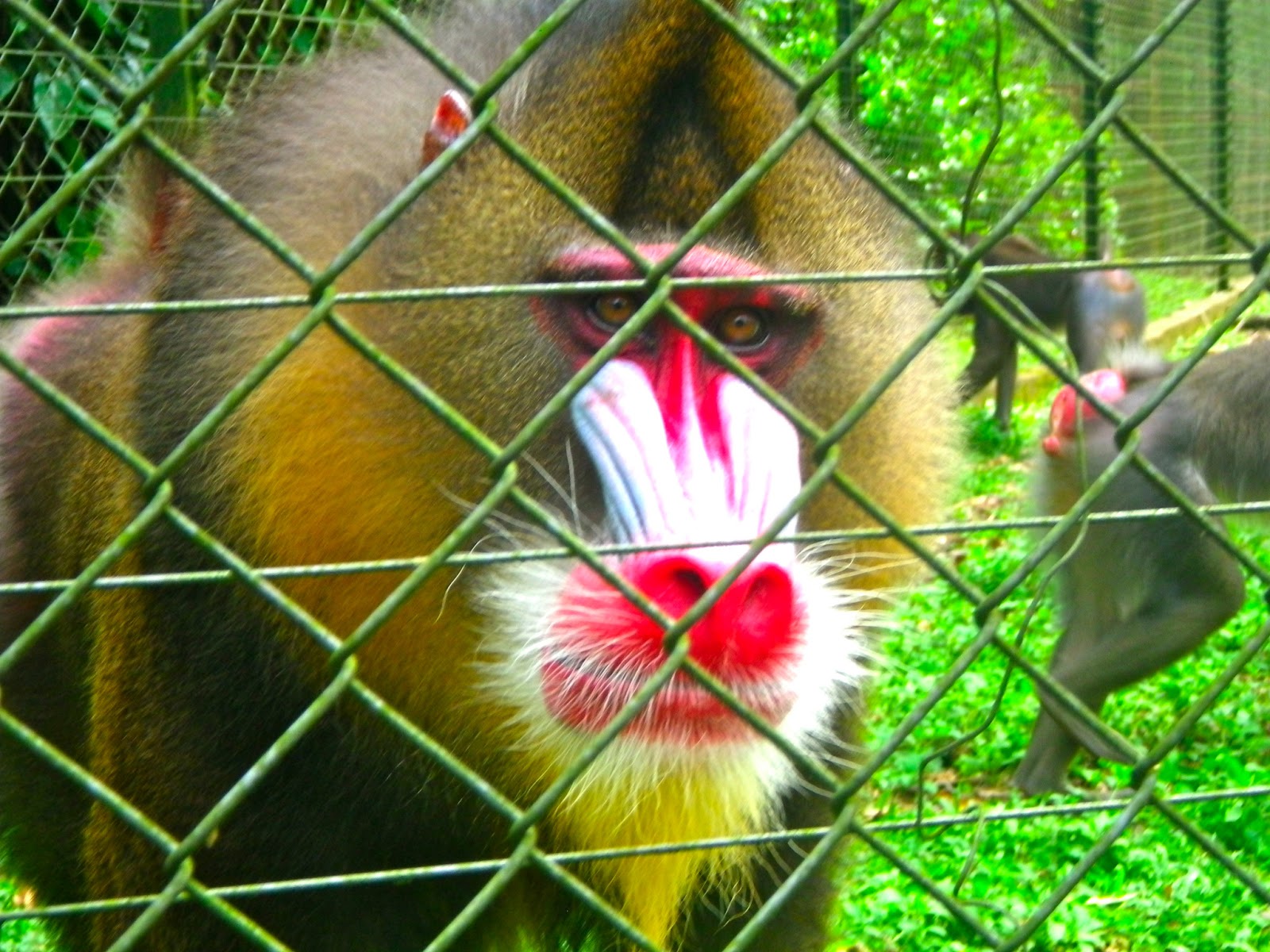
Mandrill
Monkey
On the left you can see bruise marks and on the right you see a scratch.
While visiting Mefou I was attacked by a monkey that somehow got out of
her enclosed habitat.
Our guide was showing us around the sanctuary when I saw a monkey walking around out of the enclosure. I told our guide, Elvis. At first I wasn't scared but then it ran around Elvis and headed towards me! Earlier that day Monica had told me a story about an Australian woman who had her faced ripped off by a monkey - - that story was racing through my head as the monkey latched onto my leg. Elvis advised me not to move or try to run just to be still. I listened. It let go of me and climbed a wooden poll that was directly to my right, the monkey was now at eye level with me so I slowly turned away so that my face was not in front of him, I couldn't get that story out of my head...I did not want my face ripped off. As soon as I turned, the monkey grabbed onto my right arm. She grabbed even tighter and then as she went in to bite me Elvis open hand slapped it off the wood post and onto the ground. She then became very angry and I was very scared at that point. Elvis began to distract the monkey and try to use his body as a barricade. He advised both Monica and I to slowly start walking away and moving down the path away from the monkey. I was convinced she was going to follow my scent and attack me again but thankfully she didn't and we made it out alive. Elvis said I was very lucky it was not a male or the alpha male because it would have been much more aggressive and would have bitten me for sure.
As I wondered around Yaoundé on Easter Sunday I stumbled upon Le Musée Camerounais de la Blackitude (Cameroonian Museum of Blackitude). I figured it was closed so I went to look at the hours as it was open. As I approached the front door a women came out of her house (which was situated right next to the museum) and offered to open the museum for us right then and there.
The artifacts in this museum had several different traditional purposes and significations. Most of them were from the West.
Making the long walk up Mount Fébé in the Bastos area of Yaoundé to see Le Musée d'Art Camerounais (Museum of Cameroonian Art) was definitely worth it. Unlike the first museum I visited, there was tons of information to read on nearly every peace of art in the 3 rooms. I would have loved to buy the book for future reference but it was out of my budget.
The first room had several wooden pipes of all different shapes and sizes in display cases smoked by several different classes of people and for many purposes. The book explain how all members of society smoked cannabis sativa (no joke, that was in the book); the larger the pipe base and mouth piece the high status: therefore women traditionally smoked very small pipes and chiefs smoked the largest. There was one pipe with 2 bowls and one pipe with 3 bowls which were smoked by a father celebrating the birth of twins or triplets.
Traditional masks used for ritual dances.
The next room is pictured below. It was full of statues, masks, stools and beds. Several things were made with geometric patters and/or spider legs. Spiders represented wisdom so it was used often.
One of the 3 rooms in the museum. Notice the stools on the ground: chiefs and quarter heads
would carry these from meeting to meeting, village to village - it was like their portable throne.
View of Yaoundé from Mount Fébé!
I spent the last night in Yaoundé was with some friends at Dani's house (the Algerian Consulate to Cameroon) eating homemade Algerian soup and couscous whilist taking about his work throughout Africa. We had met him our first night out on Friday at a bar where he immediately extended an invitation to dinner. We saw him quite a few more times over the weekend and was very happy to have made that connection.
In only 5 short days I feel in love with the Francophone capital. I made
so many friends that I cannot wait to visit again. I know I will be
going back soon - it was a 7 hours bus ride but very worth it. It is a fantastic place to improve my French as well - not many people speak English.
I had the Teen Mother Empowerment identification on Wednesday after I returned and had spent the entire previous week preparing. Last week I went around to different radio station in the area to broadcast messages about the program, met with the Upper and Lower Muea chief and had a friend pass out announcement/introduction fliers to all 25 churches in the village. I was certain there would be a satisfying turn out.
As I walked around Muea Village before the identification workshop, I noticed that there were some (just 1-3) very nice looking houses amongst more normal looking ones like in the picture of Maumu earlier in the post. I mentioned it to Max and he told me that when someone passes away and there is a funeral celebration, it is usually held at the families house. The family does the major remodeling/redecorating in honor of the deceased loved on and for the funeral celebration. The houses I had seen he explained, had recently had a family member die.
There was a somewhat disappointed number of attendance but my hopes are still high! I had tons of community support and many local adults were interested in helping with the program. They told me that the community center (where the workshop was held) should be full, the message was just not getting out to the teens. They suggest that we find 'social mobilizers' who will go from door to door
I'm starting to understand the logistics of the country/regions/cities
here as well. Buea is a huge city - there are more than 200,000 people
living here (which is a lot to me). Buea is in the Fako division (like a
county) of the Southwest region (like a state) of Cameroon. Inside of
Buea there are tons and tons of small villages. These small villages
each have their own chief. Traditionally, the chief is an inherited
position but sometimes it is chosen by local elders. Below the chief are
"quarter heads" which are just in charge of a very small area (like a
couple of blocks ) of the small village. Also within the village is a
"town crier" which is someone who runs around from door to door
spreading news of some sort. Sometimes the town crier is paid other
times he is not. What a neat form of communication.
Yesterday I went to the villages of Bolifamba and Dibanda which are also known as Mile 16 and Mile 14 respectively. The chiefs were not around so we left the letters introducing the program with their wives asking him for cooperation and to mobilize the 'quarter heads' and the 'town crier' so that we can get the maximum amount of participation. As we were walking around looking for the chiefs 'palace' (it is just the name of the chief's house: it is not usually like the palace on Aladan or anything) Max explained the tradition of greeting a chief. Here in the Southwest region of Cameroon and in the Littoral region right next door to us, people are allowed to greet a chief by simply shaking his hand. The Southwest and Littoral regions are both coastal regions and are what Max calls "more liberal and civilized" because they were the first areas to be infiltrated with white men, they picked up the custom of handshakes. In every other region you must greet the chief by bowing your head and getting on one knee. That is a good thing to know for when I am traveling.
Locally grown fresh bananas: 12 for 300 cfc (= $.60).
10 mangos from Maumu for 500 cfc (=$1).
While I was traveling and studying in 2011/12 I spent some time in Senegal which is where I first discovered this wonderful purple sweet juice. I never learned the name of it but frequently bought it on the street, and even paid one of my friends to make me a couple of bottles to enjoy at home. Once I left Senegal I never saw it again. To my surprise, it is a traditional Cameroonian drink and they call it Folore.
I am pleased to present you all with my first of many recipes from Africa and specifically Cameroon. Here is a short video of the preparation, continue scrolling down to see the full recipe.
Folore - le jus des ananas et des hibiscus
Ingredients
2 Pineapples
2 ½ cups dried hibiscus leaves
2 cups dried hibiscus powder
2-5 cups of sugar (to taste)
10 liters of water
*have rubber gloves available*
Directions:
Put all dried hibiscus leaves in a big bowl with the water.
Cut pineapples into large 2-3 inch chunks and put in bowl. Save all scraps in separate bowl.
Using your hands, squeeze together the pineapple chunks and the hibiscus leaves extracting all of the juice. Literally squeeze and rub the hibiscus leaves and the pineapple together – twist, rub and smash them. When finished, let it sit for 30min-1hour or more.
Transfer to large pot and add remaining pineapple scraps.
Bring to boil and then remove from the heat and set it aside to cool.
Once cooled, put on your gloves.
Remove all of the large pineapple and hibiscus chunks by squeezing all of the juice out.
Strain out all solids with a strainer.
Add sugar to taste.
DRINK and ENJOY!!!