Showing posts with label Hot. Show all posts

Friday, January 17, 2014

(part three) My Holidays: Bumpy Dusty Roads, Mystical Twin Lakes, HOT DRY SUN, and Fulfulde!!

Part One
Part Two

The Village: Rhumsiki (with pit stops in Mokolo, Kossehone, and Mogode)

We were scheduled to leave at 7am (whiteman time) Monday, but didn’t get on the road until 8am! There was hardly anything open so Megan and I had a hard time finding food. When we finally found some and headed back to the hotel, our guides had left to go fill up with petrol.

The drive from Maroua to Mokolo was short and sweet! Although it was only an hour on a newly paved road, we still managed to get a flat tire. As Njida changed the tire the three of us decided to stroll through the village on foot.


Yellow Millet
Millet is a major crop in this region. It is literally EVERYWHERE – if its not growing in the fields it is drying on top of a roof, in storage or being eaten. There are several kinds of millet and they grow in different seasons. While we were there, red millet had just finished and yellow millet was growing in the fields. 
Children were just let out from school while we were walking.
They LOVE seeing their photos!
Because we had had a flat tire, we stopped in Mokolo so Njida could get it patched before we got on the ‘bush road’ heading from Mokolo to Rhumsiki. Charles, Megan and I walked around the small town until it was fixed. We had heard of this ‘bili-bili’ drink and wanted to try it. Charels took us near the market and we found a mami who brewed her own bili-bili, a millet beer. She poured it from a massive ceramic pot into a small calabash for the two of us to share. I was happy to try it, but nothing to write home about.


Trying the bili-bili
Some photos from the drive...


Behind this cement block is Nigeria!!
We managed to get another flat tire in Kossehone, a small village that wash hosting its weekly market which we stopped by to see. After munching on some sugar cane, we were all ready to go when all of a sudden POP the tire just blew. So we munched a bit more on sugar cane and waited for the tire to be changed, again.


Above is just a short clip of something we saw while walking through one of the villages. Apparently, someone had died. The women were on their way to the deceased person's house. 

Soon we arrived in Rhumsiki! The entire drive was one of the most picturesque drives I had ever been on in my life. The only other drive I can think of that matches it would be the Avenue of the Giants in Northern California. The view from out room was absolutely stunning.

We ordered the local traditional meal, Folere. Folere is actually the name of the green plant which is then put with a groundnut sauce and meat or fish. Then you use couscous (which is french for fofo) to dip in the sauce. It was phenomenal! We then did our first hike in the valley.


Necklace worn by young girls who are trying to find a suitable husband (no shirt worn, just necklace)
The following day we worke up extremely early to watch the sunrise on top of a large hill near our hostel.
Trying to fight the morning cold by huddling in a ball.


Then we hiked around for 5-7 hours visiting surrounding villages. We met some local craftsmen and women who carved statues, made necklaces, dolls, pottery, mini guitars and much much more. 

Here are some photos from our hikes through the Mandara Mountains 
and villages surrounding Rhumsiki!

Cute little girl who was selling her handmade doll for onlye 100cfa (20cents)
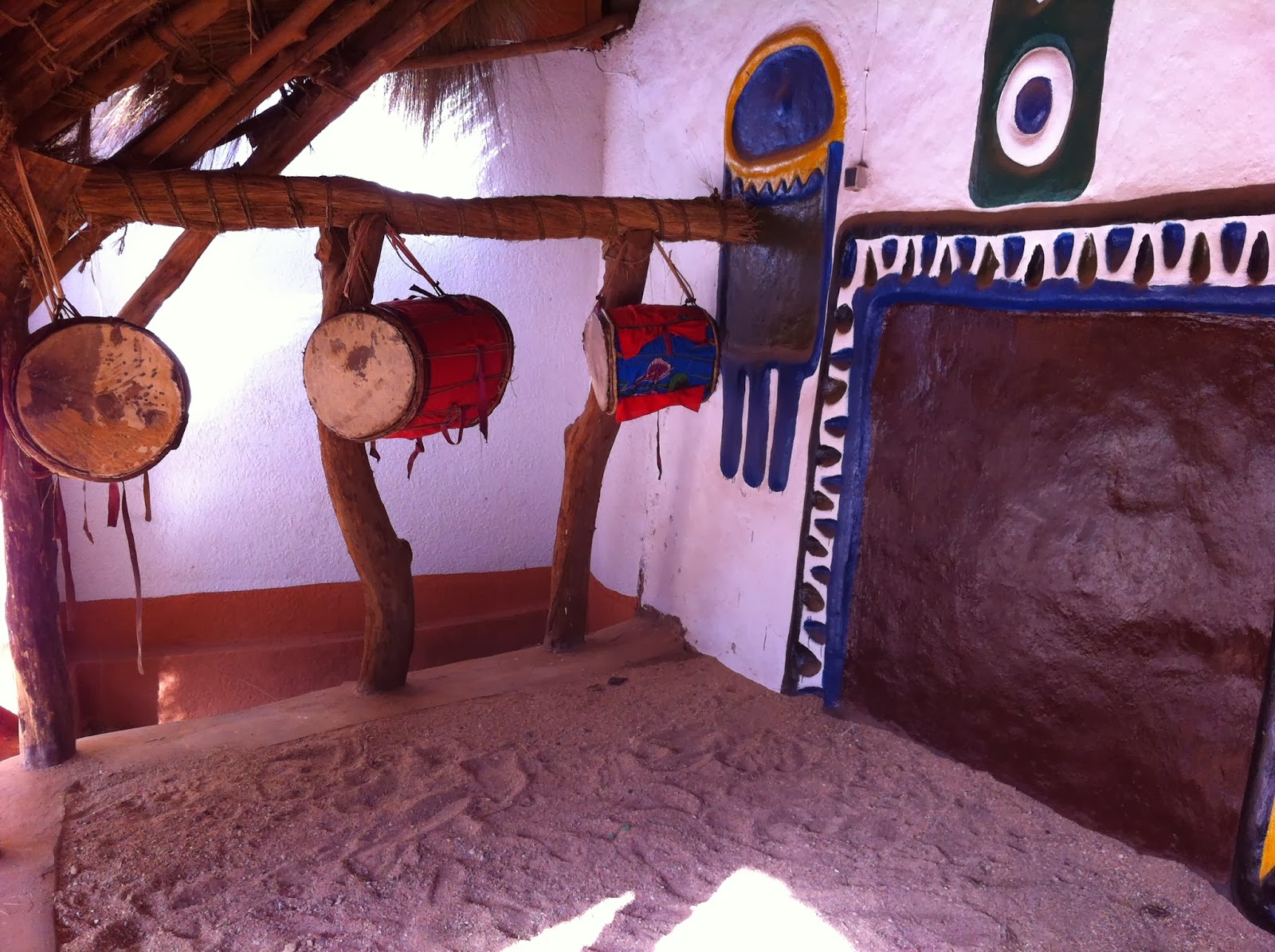
Traditional house
A fortune teller who uses a crab to see the future.


Jujub berry bush

Mamis picking jujub berries for us to buy from them.


Looks like a face in the tree!


Last Two Nights in Maroua:

At first, I was a bit intimidated and slightly concerned about how Megan and I would be perceived in the North and especially Extreme North considering all of the ruckus hat has been happening over the last year or so. Several robberies, kidnappings etc. And, just in general – it’s a very conservative Muslim population and we are two White westerners not all that familiar with their customs. I hope you all will be happy to hear that that worrying was all for nothing. We were received in the North with an abundance of hospitality just as if we were their next of kin.

We noticed that many women in these three regions had hennas! They were ‘beautified’ (as the locals say) for the New Year. It is a Muslim tradition here in Cameroon, and other parts of West Africa, for a woman to draw henna for any special holiday or festivity. Megan and I loved the designs so we went on a hunt to get one ourselves! This was a challenge in and of itself because neither of us knew the word for henna in French. So after using body language and describing it best we could in French, we finally found someone who knew where we could go to get one. We hopped on his bike and next thing you know we were in some family’s compound waiting. Soon, Ayissa Tu arrived, the woman who would be doing our hennas. We explained what we wanted and then suddenly got the idea to have her also cook her traditional meal (folere) because that was what we wanted to eat anyways. We agreed on a price and made a date for later that night.


We started out the night by eating folere! 

Work in progress

Part of the family
Like most families in the North, Ayissa Tu had tons of siblings from several different wives and one father. Her brothers and sisters crowded around the door as Megan and I took turns getting our bodies pained with what seemed to look like black Chinese hair dye.

Megan, Ayissa Tu and me!

The final product!

The outcome was fabulous! I just wish they would last longer, it has been less than a week and mine is fading fast.

Here is a sweet little reminder of the weather back home in 
Wisconsin, USA vs Maroua, Cameroon:


Major Differences Noted:
  • We saw a lot less albinos. In Southern Cameroon, I see at least two a day and even up to five. They are just more common. The entire time North I saw two total.
  • Dry, dry, dry dry soooo very dry! It was so hot but you didn’t even sweat because it was so dry!
  • The insane amount of dust surely contributes to the low life expectancy.
  • The north is seriously less developed than the rest of the country. To be honest, it was like two entirely different countries. I took the time to ask one calabash vender why he thought that was. He went on a huge rant about the President and how he doesn’t care about the North or put any money into developing it. Paul Biya has been in office for over three decades.
  • The country is divided with major religions – statistic varies but about 50% Christian, 40% Muslim and 10% Animists. Where I live, and most places in the South – it is like 90% Christian because they majority of the Muslims are in the North.
  • Nearly everyone was wearing traditional wear (the African printed fabric, the long flowing Islamic robes calle boubous) as opposed to the more Western dress of the South (jeans and tshirts).
  • Nearly every single man that we met had multiple wives. We all know that polygamy is sometimes practiced in Islam, but I was surprised to see it was that common.
  • We always saw men outside just hanging around but rarely women.  

(part two) My Holidays: Bumpy Dusty Roads, Mystical Twin Lakes, HOT DRY SUN, and Fulfulde!!

Part One
Part Three


Welcome to the Northern Regions of Cameroon 
“Bonne journee, bonne soiree, bonne annee, bonne vie!”
“Have a nice day, have a nice night, happy near year, have a nice life”
Another poor map of my Norther journey including the cities of:
Ngaoundere, Garoua, Maroua, Mokolo and Rhumsiki.


The next leg of my holidays was with Megan, a Canadian who will spend nearly one full year in Buea working for an NGO called Human IS Right. When she gets back to Canada, she will attend the very same school and study the same subject my amazing Aunty Patty has recently completed – International Development at Humber College. We had been planning this trip for over a month but didn’t make the dates and transportation final until just days before our departure. Megan went to Yaoundé a day early so she could buy our bus tickets from Yaoundé to Ngaoundere on December 29th so that we would arrive the next morning. She waited for hours at the ticket office two days in a row to be sure that we would get the cabin room with beds. I had taken the train once before in First Class and it was miserable -  totally impossible to sleep. Thankfully, all of her waiting and determination paid off because 2 people who had reserved tickets the day before in the beds, did not pay – so we got them! I met her in Yaoundé that Sunday and we traveled that night.

From here on out – nothing by French and the occasional Fulfulde (language of the Fulani people). Pretty much everyone in the North speaks Fulfulde and if people are educated to some extent they will speak French.

The Adamoua: Ngaoundere

The train departs every day at the same time. The train stops several times all along the way. Megan and I had our own little room – we played some music, drank some wine, read our books and soon fell asleep. At about 1 or 2am the train came to a sudden jerky stop. And it was stopped for over two hours. We aren’t sure if it was derailed of just a break down – both are quite common. Then an hour after we had another break down. This would have been miserable had we been in First or Second class, but since we had beds, we just slept. The train usually arrived at 7am in the morning, but we did not reach our final destination until noon. This was my second time in Ngaoundere and a main reason why I wanted to go back was to visit a good friend of mine Walid who is probably the most generous and kind man I have ever met. He is Lebonese and has been living and working in Ngaoundere for just about 7 years. We stayed at his place for the few days we were in town.

Welcom to the Lamido's Palace!!


A Lamido is a term used to refer to a ruler. In the Fulfulde language it is properly spelt laamiido and is derived from the verbal root "laam-" meaning "to rule or to lead", and hence may be translated more specifically as "leader". The title "Lamido" has been used by the traditional leaders of certain Islamic communities in West Africa, originally as head of states, nowadays persisting within post-colonial republics. His name is Mohamadou Hayatou Issa and he has been ruling since 1997 with 7 wives and 35 children. It was interesting to see a tradition like this last through colonialism. There were special areas for the Lamido to get his hair done, to rest, a place he hosted very very important guests and of course one large hut for each of his wives.

I cannot explain the sheer glee and excitement when we heard there was
a place that served banana splits and homemade ice cream!
BEST.DAY.EVER.
 
Walid is quite popular with the Peace Corps Volunteers so a big group of us (10-12) all went to Ranch de Ngaoundaba for New Years Ever. The night started out pretty terrible – our friend from the Peace Corps was robbed by a moto bike while she was walking from the PC office to Walid’s house – no more than 100meters away from each other. She didn’t let that damper the mood too much, but it definitely put everyone on red alert – especially Megan and I since we were continuing our travels. At this ranch, we were spoiled with a four course meal that started with smoked salmon and ended with brie cheese. During the meal there was some sort of mini fashion show and afterwards a small dance party. It was not the most eventful New Years Ever of my life but surly one I will never forget.

Me, Walid and Megan on New Years Ever!


Grand Mosque


Preparing for afternoon prayers.


The North: Garoua

We bought our tickets with Touristic Voyaguers on January 2nd to travel first thing the following morning to Garoua. The man at the ticket office told us the bus leaves at 5:30am and we should arrive by 5am. In Cameroonian time, this actually means the bus will leave about 7am, still, we didn’t want to chance missing the bus. We woke up at dawn and arrived at the bus station shortly after 5am. Everyone had warned us about the sun and how hot it was going to be in the North, but no one mentioned how cold it got at night!! I was shivering waiting for the bus. Finally after 45min of waiting with no busses or anything, I asked the man at the ticket office about the bus. He told me the tickets were sold out. I explained that we had already bought our ticket. He proceeded to tell me that we had missed our bus which left at 4am and would have to wait for the next one.

We were on the road by 7am – not bad. A friend of mine who had recently traveled to the North and Extreme North had warned me about the dust on the roads. She had gotten sick because of it and advised me to wear a mask to keep the dust out. I nearly forgot, until a young man came on the bus with a pack of them selling them at 100cfa each – If he came on the bus to sell them, and several people were buying them, I knew it was going to be dusty. It was about six hours on the road so we arrived early afternoon giving us time to check into our hostel and go out to explore the town.


Another form of dust prevention.
Some young man came onto the bus before it left selling the masks... thats when you know its dusty.

Women selling fruit along the roadside

Traditional houses along the drive


Garoua evolved in the 18th century and has been steadily growing in recent years to now exceeds 300,000 inhabitants. The main agricultural product in this region is cotton which provides income for more than a million people. Besides this, locals also depend heavily on the trade of petrol from neighboring Nigeria. There have only been two presidents in Cameroon, the first one was

There wasn’t all that much to do in Garoua. We spent most of our time chatting with locals (usually asking questions) and walking around the market. This city was more of a pit stop on our way to the Maroua.

Vibrant colors at the market!

Those working at our hostel told Megan and I that it wasn’t necessary to buy our bus ticket to Maroua a day in advanced. So on the 4th we woke up and took our time getting ready, packing and then heading out for some breakfast. Soon we found ourselves waiting in a ridiculously long line at the bus station for tickets. Then: they were all sold out. The woman told us to come back at 1pm because there could be another bus going. We went back at 1pm, no news yet. So we decided to try other bus agencies. National Voyaguers, another company, had tickets for a bus that was supposed to be leaving at 6pm and arriving at 10pm. The last thing we wanted to do was travel in the night – we had been warned by so many people about the instabilities during the night. They call them couper de route. Those who forcefully stop busses in the night to rob them and their passengers. We didn’t really know what to do – so we flipped a coin. And the coin said to go on the bus. Megan and I were a bit uneasy about this night travel, so just to be safe, we stuck all of our important things (money, iphone, ID) into our bras, just in case!


The EXTREEEEEM NORTH: Maroua

As we waited for the bus there was a family sitting on a mat – there were 2 grandmothers, 3 mothers and 15 or 17 children (both times I counted I got different numbers because the children were scattered on the mat and around the bus station). We left just after 7pm and surprisingly arrived around 11pm. This road was even more epic than the road to Garoua!! We were launching off mini cliffs and nearly tipped over trying to avoid a road block. There was a passenger who would get out of the bus and move rocks put in the road as a road block so that the bus could pass. It was kind of funny but also a with unsettling. I was worried about arriving late and finding a ride to the hotel but we had no problems and thankfully our hotel was just across the street from the bus agency.

The most interesting part of Maroua was no doubt the markets! But it wasn’t just any market, it was supposedly the largest Craft Market in Cameroon. Here, you really have to haggle for a good price – they are tough negotiators, but you must learn to be tougher! Don’t ever show weakness! 

Marche d'Artisanal de MarouaMaroua's Artisanal Market
Inside the market
A beautiful traditional dress I bought... will be great for teaching.
Taking a break from haggling and enjoying some Chai tea (containing far too much sugar)
Clichie (pronounced cleeshy): dried cow meat aka beef jerky!
This region is surprisingly densely populated with about 20% of Cameroon’s population yet is also the poorest region with a high rate of illiteracy and lower than average life expectancy. They call the US a ‘melting pot’, right? Well, you could also call this reach a melting pot – the region includes the dominant Fulani, Kirdi, Mofu, Choa, Moundang, Toupouri, Mafa, Kapsisi and Mousgoum people. And those are just the inhabitants – think about those who move from other regions of Cameroon for work.
Busy Maroua
My friend who had recently traveled here had recommended a guide for Megan and I for when we traveled. We had made arrangements while we were in Garoua and scheduled two days and one night in Rhumsiki hiking through the Mandara Mountains. We met our guide, Charles and our driver, Njida, Sunday afternoon to ask questions, get ourselves acquainted and discus details of the trip.  

Part One
Part Three